How to select the correct MEAN WELL Charger & Lithium Battery
In recent years, the world has witnessed a significant shift toward sustainable energy solutions, with lithium-ion batteries emerging as a cornerstone of this transformation. From powering electric vehicles to storing renewable energy, lithium batteries have become increasingly vital in our quest for cleaner, more efficient energy systems.
Lithium batteries play a crucial role in modern energy storage and power solutions. Among various lithium-ion chemistries, two major types are NMC (Nickel Manganese Cobalt) and LFP (Lithium Iron Phosphate). Both have unique properties that make them suitable for different applications in industrial, consumer electronics, electric vehicles (EVs), and renewable energy storage. Today, MEAN WELL Europe offers a complete solution with a smart charger and lithium battery pack. By understanding every customer’s needs, we provide standard and personalized solutions.
We invite you to join us in exploring lithium batteries. We will uncover how these remarkable energy storage devices are changing the way we live and work and influencing the global transition to a more sustainable energy landscape.
Batteries offered by MEAN WELL Europe
Nowadays, the dynamics of the energy sector are rapidly changing, and the electrification process is accelerating. MEAN WELL Europe has expanded its product offering by including IoT-connected lithium batteries, which are made in Europe.
Here is the Lithium Battery offering from MEAN WELL Europe.



Advance Battery
Coming soon
Part 1: Batteries
1.1 How does a Battery work?
A battery has 2 poles, a positive and a negative pole, depending on whether you charge or discharge the battery, a reaction takes place in which electrons move from the positive to the negative side.
This effect is called a redox reaction (reduction-oxidation), in which the electrons are released from the cathode (reduction) and bind to the anode via an electrochemical reaction (oxidation). This creates a potential difference and electrode current, which can be used to drive a user, such as an electric motor.
These anode and cathode have the largest possible surface area and therefore consist of layers or are rolled up in a cell. The cell contains electrolyte in which the electrons can move freely from the anode to cathode.
1.2 Types of batteries
Basically, there are 3 types of battery, these types are divided into subcategories.
- Lead Batteries: divided into AGM and GEL
- Lithium Batteries: divided into NMC, LiFePO4, and the rest.
- The rest: divided into NiCd and NiMH, among others.
1.3 Lead-acid Batteries
For years, these were the most common batteries worldwide. Most are of the AGM (Absorbed Glass Mat) or GEL type.
With the latter, the electrolyte is incorporated in a kind of gel. The advantages of AGM batteries are the higher discharge currents than what is possible with gel. Because the electrolyte in gel batteries is processed in a gel, the electrons can move less freely. An advantage about GEL batteries is that you can usually mount them in multiple positions (such as upside down), which is usually not possible with AGM batteries.
These batteries can usually be discharged much deeper on a regular basis without high levels of chemical wear. A term you will also encounter is SLA, which means sealed lead acid and does not mean anything other than that these batteries are completely closed and cannot be refilled with electrolyte, which also applies to MF (maintenance free).
1.4 Lithium Batteries
Here we only discuss about NMC and LiFePO4 batteries. There are many other types of batteries that are based on lithium. NMC, or Nickel Manganese, Cobalt Oxide is a very popular chemical compound, commercially strong due to the favourable cost of ownership.
The NMC cells can be supplied as Polymer (LiPo) in the form of a rectangular so-called “pouch cell” and in a cylindrical shape such as the very popular 18650 cell shape, they are then called lithium ion (li-ion) cells. The disadvantage of LiPo cells is the higher initial costs and the lack of a CID (Current Interrupt Device), interrupts the circuit if the cell temperature is too high. This could, for example, occur during charging if the cell is broken. The CID is incorporated in the positive pole of the cell.
LiFePO4 basically has a longer lifespan than NMC due to the lower wear rate, but because the energy density and nominal voltage are lower, you need more cells to achieve the same power as NMC cells. This results in a higher cost price and a larger and heavier battery than what is possible with NMC. The positive point of LiFePO4 beyond its lifespan is the safety attributed to the cells.
1.5 Voltage (V)
Lead-acid batteries have a nicer linear decrease in voltage during use than lithium. Lithium has a flatter curve, roughly between 10% and 90% of the discharge time.
How do we arrive at the voltages indicated on a battery?
To do this, it must first be explained what exactly “nominal voltage” means. This nominal voltage is the average voltage of the battery (the voltage of a battery therefore slowly decreases during consumption). This average voltage is used as the calculation voltage and is called the nominal voltage.
You can calculate this nominal voltage by multiplying the number of cells in series by the nominal cell voltage below.
- NMC (Li-ion/LiPo) 3.6/3.7V
- LiFePO4 3.2V
- Lead acid AGM/GEL 2.0V
Now we come to the voltage indicated on a battery or charger, which is usually an approximation of the nominal battery voltage. So for which type of battery the charger is suitable. This is usually correct with lead/batteries. There are more differences and creative approaches with lithium batteries because the older lead-acid batteries are taken as a reference. For example, 12V can be made very nicely with 2V nominal cells, but with 3.6V Li-ion cells this is of course not possible and 3S or 4S is often used, both of which are called a 12V battery, which is of course not entirely correct.
When a very high power is required from a battery, the voltage of the battery drops at that moment, this is a phenomenon called voltage drop. This effect is caused by the resistance in the battery, so much energy is required from the battery that the redox reaction does not go fast enough. This occurs, for example, when a starter motor in a combustion engine is activated, the required current is so high that the voltage (temporarily) drops.
1.6 Capacity (Ah or Wh)
The capacity of a battery, also known as ampere hours (Ah), is determined by the total surface area of the anode and cathode per cell and how many of these cells are in parallel.

Suppose the cells in the above diagram have a capacity of 10Ah each, then the total capacity is 10*4= 40Ah. If the cells in this example have a voltage of 2V, the voltage of the entire system remains 2V.
Although capacity is often expressed in Ah, it is more accurate to express the capacity of a battery in Wh (Watt hours), or Voltage (V) * Ampere hours (Ah). This applies in particular to all batteries that are not based on lead acid or 1.5V penlites. For all other forms, including lithium, the voltage is often rounded to an equivalent lead-acid battery variant.
As an example; take a 12V 10Ah lead battery and a 12V 10Ah li-ion battery. You would initially say that the capacity of both batteries is the same. The capacity of the lead acid battery in Watt hours is 12*10 = 120Wh. For the lithium battery you must first know whether this is a 3S or 4S version to approach 12V, after all 3*3.6V = 10.8V and 4*3.6V = 14.4V. In other words, 12V cannot actually be simulated well with li-ion cells, yet it is offered. Let’s assume it’s 4S. Then the sum becomes 14.4V*10Ah is 144Wh. Basically more effective than the lead battery, and then we leave the Peukert effect aside.
Part 2: Chargers
2.1 How does a charger work?
A charger works by applying a certain voltage (V) and current (A) to a battery. That is why there is always a voltage and current indicated on the label of a charger. Please note that the current of a charger is indicated in A of amperes, so this is slightly different from the capacity of a battery, which is indicated in Ah (ampere hours).
You can calculate how quickly you can charge your battery with a particular charger based on the charging current A of the charger and the capacity in Ah of the battery. You can charge a 20Ah battery in about 4 hours with a 5A charger (20/5). – It is an approximation, depending on the charging phases that the charger has.
2.2 Which charger do I need?
Which charger you can use depends on which type of battery is used, so you all need different chargers for the batteries below:
- NMC (li-ion/LiPo)
- LiFePO4
- Lead/acid AGM
- Lead/acid GEL
The charging characteristic for all the above batteries is CC/CV, which means constant current/constant voltage. In other words, first, it is charged with a constant current (the current indicated on the charger), then with a constant voltage. While this voltage is maintained, the current drops to the charger’s cut-off point. For different types of batteries, there are different specified charging currents at that point.
Please see below; this is a typical CC/CV charging curve for 2/3 stage charging curves. It depends on the characteristics of the battery that you are using. This is the MEAN WELL spec of NPB-750 for your reference.

In addition to this 1st phase (CC) and 2nd phase (CV), MEAN WELL smart chargers have additional phases depending on whether it is a lead or lithium charger (2 or 3-stage selectable via DIP S.W on panel or set via SBP-001, Intelligent Battery Charging Programmer). For example, lead-acid chargers have a float mode as the 3rd phase, in which the batteries are kept at a fixed voltage with a small current. The lithium chargers have a “rest phase” as a 3rd phase in which the voltage of the battery drops. If the voltage falls below a preset level, the charger switches to another phase, which is known as a topping charge.
The correct charging voltage and current are essential for safely charging a battery. You have to calculate the correct charging voltage yourself if you know how many cells in the battery are in series. Each chemical composition has its own charging voltage per cell. Here are the (maximum) charging voltages per composition:
- NMC (Li-ion/LiPo) 4.2V (sometimes 4.1V)
- LiFePO4 3.65V
- Lead/acid AGM 2.37V-2.45V
- Lead/acid GEL 2.41V-2.45V
A Li-ion battery with a nominal voltage (the average battery voltage) of 48V with 13 cells in series (13S) therefore requires a charging voltage of 54.6V.
The other factor besides charging voltage is the charging current. This depends on what the battery can handle. The higher this current, the faster you can charge. It is recommended not to charge a battery or product faster than originally indicated. The data sheet of a battery often states the maximum current allowed. We strongly recommend always staying well below these maximum values.
2.3 What does the voltage indicated on the charger mean?
This is the nominal voltage, or in the case of lithium batteries often the rounded nominal voltage but it will lead to different results of different Wh. See this in Part 1: Batteries, 1.6 Voltage. Different devices require different voltages to charge properly, so it’s important to use a charger with the correct voltage to avoid damaging the device.
2.4 Power of a charger
You can calculate the power of a charger by multiplying the charging voltage by the charging current. In the case of 42V charging voltage and 5A charging current, you are at 210 Watts. So you will have to use a MEAN WELL smart charger of the 240Watt type.
The MEAN WELL chargers are available for different capacities, use different charger series for different application requirements.
Please see below for MEAN WELL charger offering.


2.5 Benefits of using a lithium battery with BMS
- Safety: BMS helps prevent overcharging, over-discharging, and overheating, which can improve the overall safety of the battery system.
- Extended Battery Life: The BMS can help optimize the charging and discharging cycles, which can extend the lifespan of the lithium battery.
- Efficiency: BMS helps monitor and regulate the flow of energy, ensuring that the battery operates at its most efficient levels.
- Performance Optimization: BMS can enhance the performance of the battery by maintaining consistent power output and protecting it from damage due to misuse or environmental factors.
- Monitoring and Diagnostics: BMS provides real-time monitoring of the battery’s health, allowing users to identify any issues promptly and take corrective actions.
- Balancing cell voltages: ensure that all cells are charged equally. This helps to extend the battery life and improve its performance.
- Analysing battery data: collect from the sensors to determine the battery’s state and condition and provide real-time information about the battery’s performance
2.6 MEAN WELL “Smart Charger + Lithium Battery”
- Screw mount type of smart charger
| MEAN WELL Charger | Number of Lithium Battery | |
| a | 1pc of NPB-450-48 or NPB-750-48 |
|
| b | 1pc of NPB-1200-48 |
|
| c | 1pc of NPB-1700-48 |
|
| d | 1pc of RPB-1600-48CAN |
|
| e | 1pc of RPB-1600-48CAN |
|
* The charging time depends on the amount of charge current with the selected charger
* C version battery incorporates a connector of M12 (A-coded/5pins), for CANBus communication
* Please contact your local MEAN WELL representative for accessories
* The recommended number of battery is only for reference. Please perform the overall evaluation with the final system.
| No CANBus Battery-pack has built-in BMS, you can connect it to a power supply(constant voltage) if you only use one battery. |
 |
| With CANBus – M12/A-coded/ 5 pins It is highly recommended to use this version with CANBus to optimize the charge/discharge current if you connect batteries in parallel |
 |
- IP6X solution
| MEAN WELL Charger | Number of Lithium Battery | |
| a | 1pc of HEP-600C-12 |
|
| b | 1pc of HEP-600C-24 |
|
| c | 1pc of HEP-600C-48 |
|
| d | 1pc of HEP-1000-24W(CCAN) |
|
* The charging time depends on the amount of charge current with selected charger
* C version battery incorporates a connector of M12 (A-coded/5pins), for CANBus communication
* Please contact your local MEAN WELL representative for accessories
* The recommended number of battery is only for reference. Please perform the overall evaluation with the final system.
CONCLUSION
MEAN WELL EUROPE created the platform of one-stop solution for lithium battery and smart charger to help you to shorten the development time & give the added value on your system design. This platform provides many advantages, you will benefit from quick response and the local technical support in Europe for both battery and charger/power-supply. It’s an approach that seeks to optimize the balance between cost and quality from your perspective, to make better decisions about what are the best investments for success.
MEAN WELL has various types of smart chargers and power supplies, from 30W up to 3200W. The lithium battery-pack can be able to communicate with the smart charger via the optimized interface to achieve the excellent performance in the entire solution that customer needs.
Contact us if you have questions on selecting our batteries or chargers.
Learn more about Charger & Lithium Battery
Explore our blog for insightful technical notes about Charger & Lithium Battery Applications.
Got questions?
Look at the section below to find the most frequently asked questions (with answers)
we received in Charger & Lithium Battery Applications.
The GTIN number can be found directly on the www.meanwell.com:

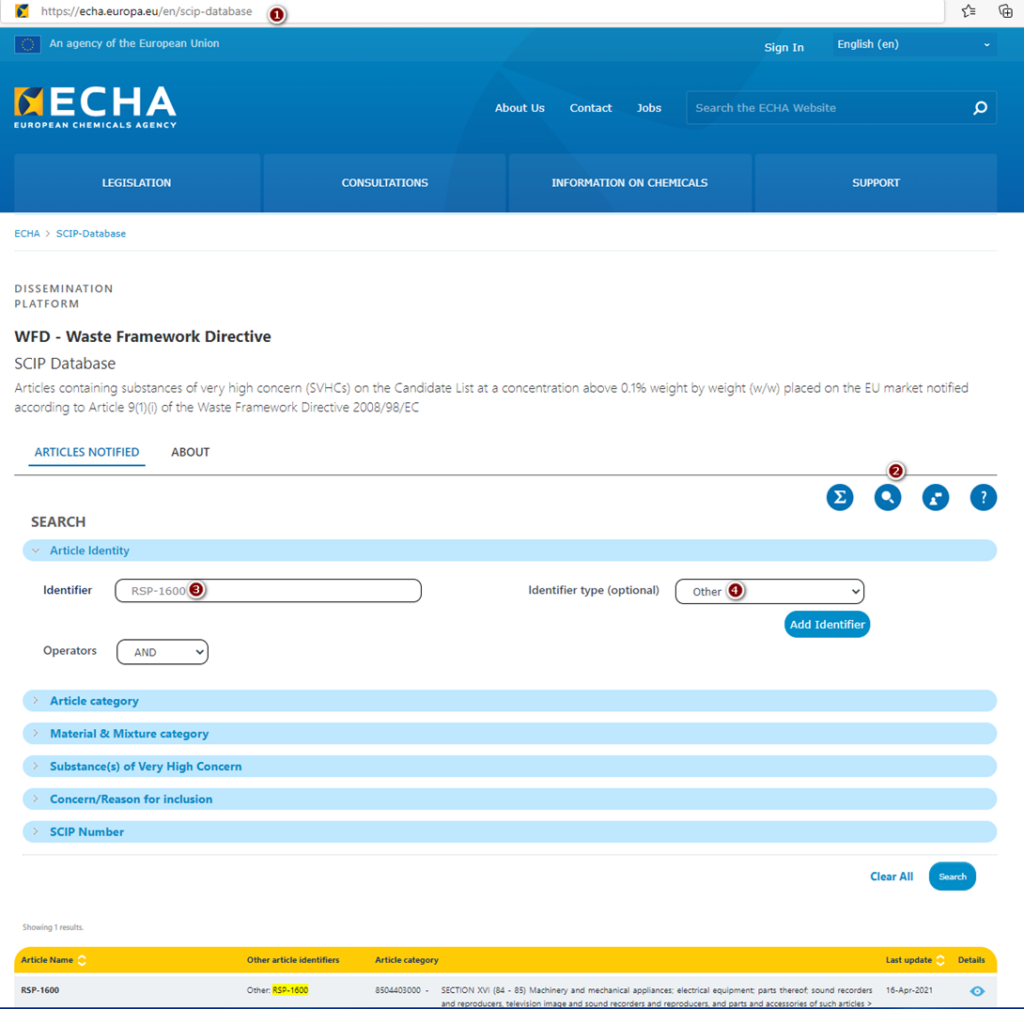
Yes, MEAN WELL products are registered in SCIP. To get such information for specific power supply, please follow the steps below:
- Go to https://echa.europa.eu/en/scip-database
- Under SEARCH option, choose „Article Identity” and write down model name e.g. RSP-1600.
- As “Identifier type (optional)”, please chose “Other”
- Click “Search” button
The declaration of Five PBT TSCA Conformity can be found on the last page of Installation Manual e.g. below:

A Surge Protection Device is optimized for a single voltage. Therefore, SPD should be chosen according to the actual operating voltage of the part that need to be protected.Secondly, the voltage protection level shows what is the maximum voltage appeared at output side when a specified surge is coming to the SPD. In general, the lower the voltage protection level, and the higher the discharge or surge current from SPD, means the better protection that the SPD provides.
Owing to line (voltage)-drop, we suggest the extension made from AC cable. In case DC cable extension is necessary, please consider Line-Drop leading to insufficient Vf so that the LED model or lamp may fail to switch ON. Moreover, EMC performance and characteristic may also be affected by DC cable extension.
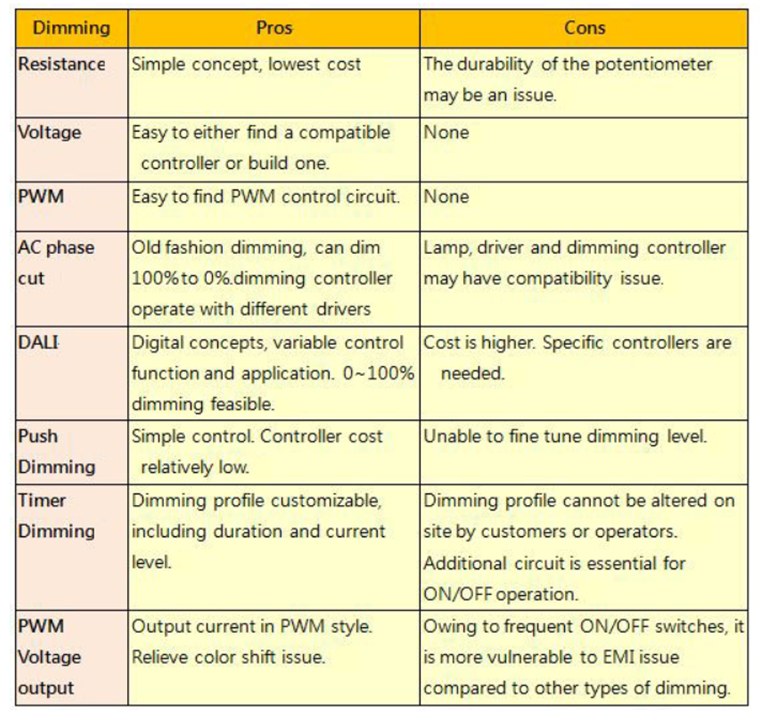
There are so many MEAN WELL dimming products. How can I make a choice? What are the pros and cons?
First, you have to know your Led lamp specification in order to screen out a suitable Led driver range (Wattage, Voltage, Max Current CC or CV). From those ranges, further check a compatible dimming function. Hereunder is a table to show you the pros and cons of Dimming Function you can find in MW’s catalogue.
MEAN WELL has several charger products, and we suggest choosing them first. Chargers would be more suitable since they are designed for charging applications. Safety and approvals should be taken into account based on the final application. If you are unable to find a proper model in our charger series, our LED CC models can be used as charger. Please choose suitable products after confirming the current and voltage specification on the datasheet of the battery.
3 in 1 dimming circuit would drain 0.1mA per model. Dividing the rated current of the dimmer by the 0.1mA, and we could know how many units can be controlled by one dimming device. For resistance dimming applications, resistance for 100% dimming output would be 100K ohm divided number of models.
A LED strip is normally a Constant Voltage application (CV). For this type of CV application MEAN WELL has design the PWM, IDLV and ODLV series which will allow CV applications to dim.
3 in 1 dimming is the most common application used in LED dimming with the feature that it does not have to work with any specific dimmer. The only thing that has to be verified is that whether the dimmer (1~10V/10V PWM/resistance) is compatible with the definition advised in our specs.
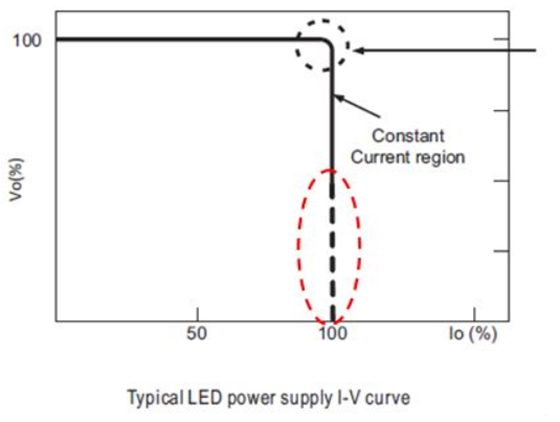
MEAN WELL’s LED product specification normally exhibits V-I characteristics. Per the characteristics, there are generally two types of drivers, the “CC” type and the “CC+CV” type. “CC” type of driver is suitable only for LED applications whereas “CC+CV” is for either LED applications or general switching power supply applications. The section that is not suitable for LED applications are represented by dotted line, and based on the protection procedures it can be categorized into hiccup mode and constant current mode; in this section, the tolerance of current is not defined but only the characteristic of current is displayed. If customers attempt not to see a very high current under short circuit conditions, those models with hiccup mode for this section can be selected; if there are applications with motors or capacitive load, those with constant current can be chosen.
There are 2 types of Power Factor Correction circuits; one is Single Stage; the other is Two Stage.
Single Stage power supply combines functions of power factor correction and converter in one circuit but Two Stage use two separate circuits. Compared to Single Stage, Two Stage design is more complex and costly, but the immunity performance of Two Stage power supply against AC mains is much better than that of Single Stage power supply. In addition, Two Stage power supplies manifest better ripple noises performance on output. Owing to that Single Stage is only suitable for fields with quality AC mains but Two Stage can be used in serious circumstances for LED drivers or as industrial switching power supplies.
Depending on the installation environment, you may need IP certified power supplies (IP65/IP67).
Also, waterproof connectors and junction boxes are useful accessories to ensure a reliable operation in damp environments (please refer to the LED power supply installation manual).

Waterproof connector solution
Junction box option
Note that the MEAN WELL product IP level, including IP67, is tested according to IEC 60529. The protection does not guarantee for permanently immersing in the water. Please check the device installation manual for proper suggestions on installation.
MEAN WELL developed many power supplies series specifically for LED application. Single stage PFC was used in such developments due to low cost. This topology has the following restrictions:
AC fluctuation
- This topology does not use input bulk capacitor. For this reason, in areas with low AC quality, output voltage and current may become unstable causing variation in LED brightness. If the input AC voltage is stable, then this problem will not occur.
- Output ripple
This is also caused by lack of input bulk capacitor. As compared to power supplies using two-stage PFC, the ripple will be significantly larger (see Figure 4). There could be instances where the low end of the ripple may be too low for the driver IC to operate properly, and the LEDs will start to flicker. To solve this type of problem, the output voltage can be adjusted higher, so the low end is higher than the driver’s minimum working voltage. Or simply select a PSU with higher rated voltage.
- Current harmonics
Single stage PFC power supplies are optimized for constant current drive. Using these supplies as constant voltage sources (such as application including cascading a constant current driver IC), the harmonics might be worsening in this case. When operating in areas with unstable utility voltage or with driver IC, we highly recommend using general application types as found in table 1. Avoid using single stage PFC if possible and use a two-stage PFC power supply instead, or contact MEANWELL for more information.

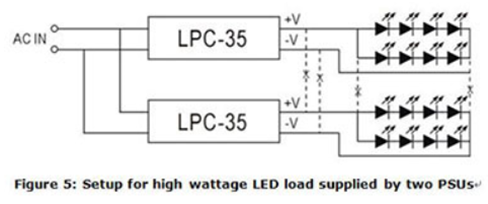
MEAN WELL LED power supply does not have a parallel “current sharing” function, so it is not suitable for parallel connection. For high power requirements, please select higher wattage power supply or divide LED load into smaller subsections to be powered by individual power supplies. Example of such LED configuration can be found in figure 5. As shown in fig. 5, the connection between -V of the LPC-35 units should be severed and not connected in common. On the contrary, small wattage LED loads can be connected in parallel and be powered by a single high wattage power supply. But the ability to divide current evenly must be taken into consideration.
First of all. Determine the driving method of LED lamp. If the lamp is driven by constant current, forward current shall be within specification. On the contract, if it’s driven by constant voltage, then user must check if they are using the right product to dim the LED lamp, such as PWM/IDLV/ODLV series.
LDD/LDH series comprises switching components; series or parallel connection will damage these switching components.
Depending on the circuit design, there could be different operational problems. See below:
- Boost mode driver IC:
The startup voltage of such driver IC is significantly lower than the total LED forward voltage. For this reason, the IC will start up at very low voltage level usually about 1/2 of the power supply’s rated voltage and to meet rated power requirement, the startup current will reach 2 times the power supply’s rated current. When the power supply is unable to provide this current, the LED CC driver will not activate.
- Buck mode driver IC:
If the selected power supply voltage is significantly higher than the LED forward voltage. For example, power supply provides 48V and the LED lamp only needs 24V and the power ratings are equivalent. When power supply voltage reached the LED conduction voltage, the power supply will immediately go into constant current mode. At this moment, the required power to start up the LED + driver is larger than what the power supply can provide causing malfunction of the driver circuit and the power supply to be clamped at LED forward voltage. For boost mode design, we recommend raising the startup voltage of the driver IC to be as close to the power supply voltage as possible or incorporate soft start function (see fig. 3). Wait until the power supply voltage is established before starting the driver. When selecting power supply for buck mode, the output voltage of the power supply should be as close to the LED total voltage as possible with excess power available (LED power/0.85).
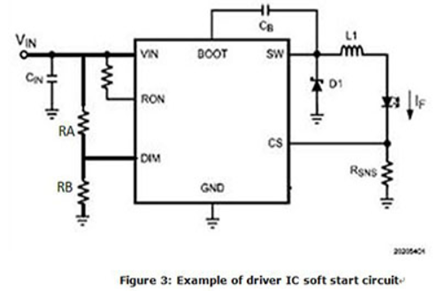
DIM PIN is the startup pin for most PWM based driver. It can also be designated as EN (Enable). DIM (or Enable) is at 0V the internal connection to SW pin will be open. When the DIM voltage reaches 1.5V (Typ), the IC will Turn ON. To set the Vstart for the DRIVER IC: Vstart = (VDIM/RB) x (RA+RB). The general rule is to set the Vstart at 5~10% higher than the total LED forward voltage.
With 1~10V dimming, the lighting unit can be dimmed down to 10%; with 0~10V dimming, it can be dim down to 0%, or say, dim-to-off.
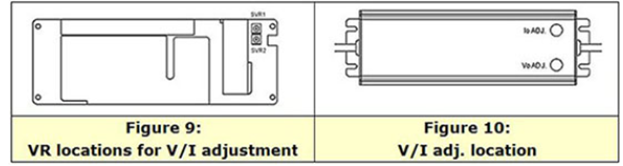
LED power supply comparison table to see which MW LED power supply allows for V/I adjustments. A suitable unit can be picked based on the type of adjustment required. For the allowed adjustment range, please refer to the spec sheet. Tuning of the voltage and current levels can be done through the built-in VRs/potentiometers. PLN/ELN requires removal of the top cover in order to access the internal SVR1 and SVR2, see figure 9 for VR locations. For other series, the VRs can be accessed through IoADJ and VoADJ holes after rubber stopper removal. After adjustments have been made, please make sure rate power is not exceeded and the rubber stoppers are properly reassembled.
MEAN WELL’s specification shows the absolute values which were verified during design quality verification tests. Those condition are guaranteed by manufacture from quality and warranty perspectives.
When certifying a power supply according to a certain norm, there is normally a requirement described in this standard a certain tolerance which must be considered. (See also FAQ: Why Is The Input Voltage On The Label Different From The Input Voltage In The Spec? For Example, The Specification Shows Is 88~264 VAC While The Label On The Power Supply Says That It Is 100~240VAC?)
The specification shows what is possible, the report and label of the power supply shows what is approved by the certifying body according to the standards.
Besides the difference due to tolerance there might also be another reason why the specification and label/test report show a different temperature. For example, if the power supply needs to be derated at a low voltage input such as 100VAC, the label and test report might show the max temperature at full load based on this low input.
Different standards might have different tolerance requirements and different ranges this could mean that the most conservative value, or multiple values will show up on the label of the power supply.
MEAN WELL has incorporated dust proofing and waterproofing into the majority of its LED power supply design. Mainly based on the international standard IEC60529, detailed descriptions can be found in the following table:
(Note: PSUs with IP64 rating or above are suitable for indoor or outdoor applications in sheltered locations)
IP xy protection level
| Degree of protection, foreign bodies (x) | Degree of protection, moisture(y) |
| 0. Not protected 1. Solid foreign object (>50mm) 2. Solid foreign object (>12mm) 3. Solid foreign object (>2.5mm) 4. Solid foreign objects of 1,0mm diameter and greater 5. Amount of dust that would interfere with normal operation Dust tight | 0. Not protected 1. Vertically falling water drop 2. Vertically falling water drop when enclosure is tilted up to 15 degrees 3. Water sprayed at an angle up to 60o on either side of the vertical 4. Water splashed against the component from any direction 5. Water projected in jets from any direction (12.5 liter/minute) 6. Water projected in powerfil jets from any direction (100 liter/minute) 7. Temporary immersion in water ( 1 meeter from the surface of the water for 30 minutes) 8. Continuous immersion in water, or as specified by the user / manufacture |
*IP64-IP66 level products are suitable for damp indoor or sheltered outdoor environment. For actual installation limitations, please refer to the corresponding IP level tests.
*All products cannot be continuously submerged in water.
*The definition of IP68 by MEAN WELL: Immerse a unit under test in 1 meter below the surface of the water, tested with a dynamic condition where 12-hour AC on; 12-hour AC off.
Test duration: 1 month.
MEAN WELL’s DMTBF can be found on www.meanwell.com
Please note that the DMTBF is not for every model available. Mostly this information is available for the LED drivers and our latest product releases.
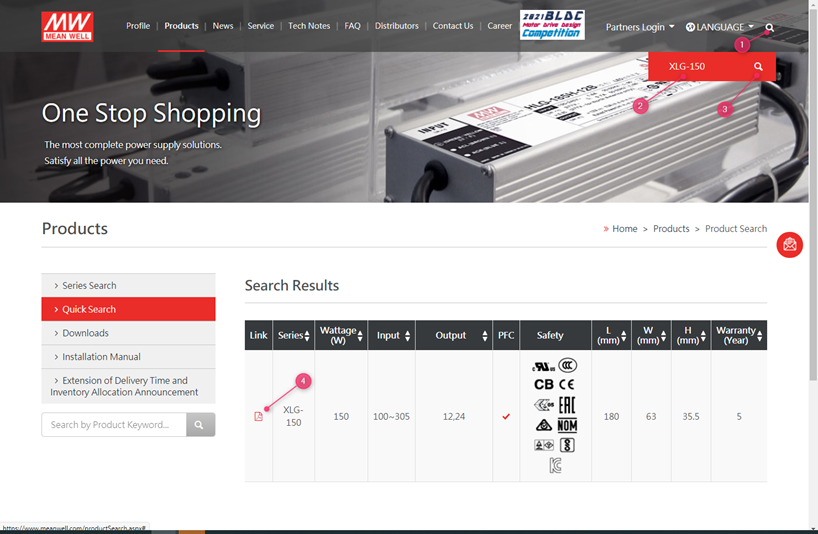
1. Use the search function on the website to find the right product
2. Fill in the series number in the search field (do not include the last extensions such as -12 in XLG-150-12)
3. Click the search button
4. Click on the PDF icon to open the specification
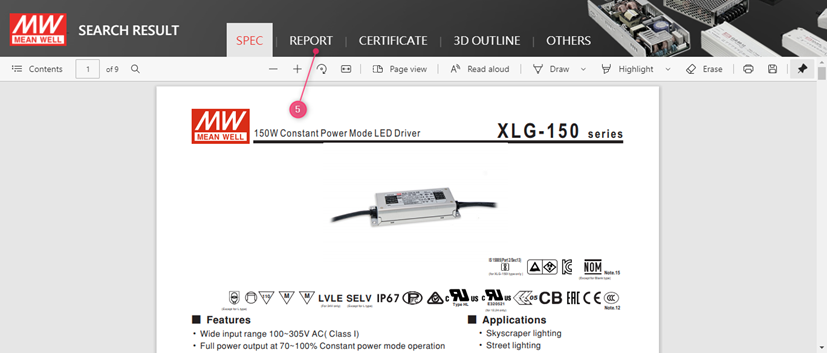
5. Click on report
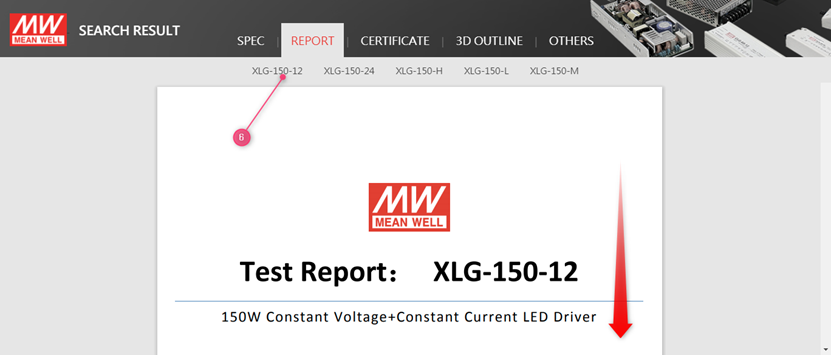
6. Click on the model and scroll down:
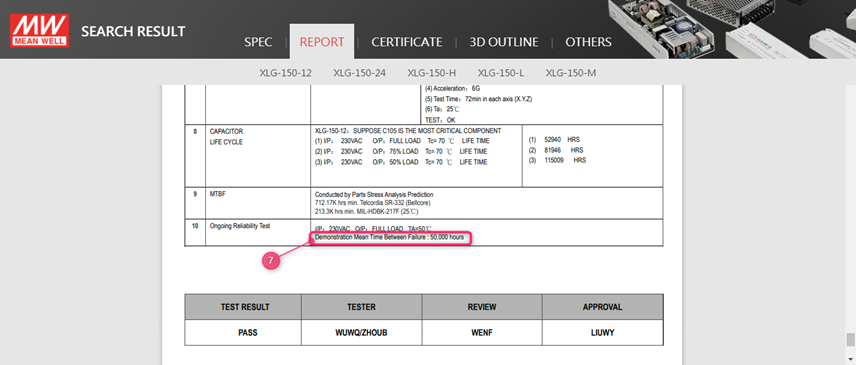
7. The DMTBF is shown on the last page of the report in the chapter Reliability test
LED Drivers are recommended operate at full load as long as it observes the working temperature specified in the datasheet, which means Tc measurement results should be equal to or less than the stated Tc in the datasheet. 5 years warranty complies as long as drivers operate within working Temperature and Tc. Limit as well.
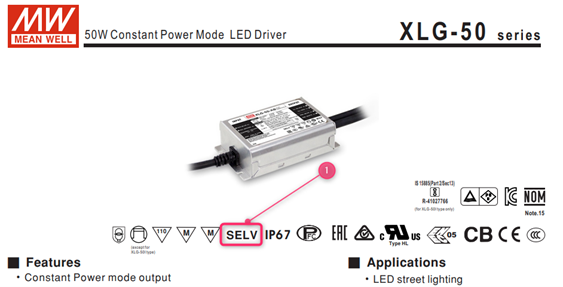
No, they are different. SELV means the LED driver will use a safety isolating transformer with double or reinforced insulation and the output voltage shall not exceed 120Vdc.
This is good for the end product safety certified if the LED driver with SELV output.
The definition of SELV was defined in the IEC 60950 standard but it is not defined in the IEC 62368 standard. This has been replaced with the ES1 Energy sources definition.
The definition of SELV is still applicable to the 61347-2-13 standard. In this standard it is that a LED driver will use a safety isolating transformer with double or reinforced insulation and the output voltage shall not exceed 120Vdc.
In the specification MEAN WELL’s 61347-2-13 certified LED drivers are marked with the SELV symbol in the case that the SELV requirements are fulfilled: